
The Creation of the Soviet Airborne Forces: Origins and Early Development (1928–1941)

The Soviet Airborne Forces emerged not as a sudden innovation, but as the result of deliberate experimentation driven by operational necessity, technological opportunity, and doctrinal ambition. From their earliest beginnings in the late 1920s, Soviet military planners viewed airborne troops not as auxiliaries, but as an independent instrument of deep operations — a concept largely unprecedented at the time.
Early Experiments: 1928 and the Central Asian Experience
The practical origins of Soviet airborne capabilities can be traced to 1928, during counterinsurgency operations in Central Asia against Basmachi bands. In this context, aircraft were used for the rapid redeployment of cavalry reserves, marking the first instance in which air transport significantly altered operational tempo.
Using Junkers Ju 13 transport aircraft, elements of cavalry brigades were swiftly relocated across vast distances. Although no parachute landings were conducted at this stage, the operation demonstrated the military value of air mobility: speed, surprise, and flexibility. These lessons would later form the conceptual foundation of Soviet airborne doctrine.

Parachutes and Foreign Technology
At the end of the 1920s, the Soviet Union lacked reliable parachute technology suitable for mass military use. To address this gap, in 1929 the Red Army procured the first rescue parachutes from the United States. Initially intended for aviation safety, these parachutes became the basis for experimental troop deployment from aircraft.
This acquisition allowed Soviet specialists to begin systematic testing of airborne insertion, transforming parachuting from a civilian and emergency technique into a military capability.
The First Airborne Unit
Building upon these experiments, the Soviet command established the first independent airborne military formation, the Experimental Airborne Detachment (Opytniy Vozdushno-Desantniy Otryad). This unit became the nucleus around which future airborne forces would develop.
Its tasks included:
Testing parachute deployment techniques
Developing landing and regrouping procedures
Evaluating weapons and equipment suitable for airborne troops
The existence of a dedicated unit reflected an important doctrinal shift: airborne forces were no longer an experiment, but a recognized branch of future warfare.

The 1931 Maneuvers and Tukhachevsky’s Vision
A decisive step forward occurred in 1931, during large-scale military exercises conducted under the supervision of Marshal Mikhail Tukhachevsky, one of the principal architects of Soviet deep battle theory.
During these maneuvers, troops performed parachute jumps from TB-1 bombers, an aircraft originally designed for strategic bombing. The use of heavy bombers for troop deployment illustrated both improvisation and ambition — the Red Army was willing to adapt existing platforms to explore new operational concepts.
Tukhachevsky viewed airborne forces as a tool for:
Disrupting enemy command and logistics
Seizing key terrain in the enemy rear
Supporting mechanized breakthroughs
His influence ensured that airborne forces were integrated into broader operational planning rather than treated as isolated special units.
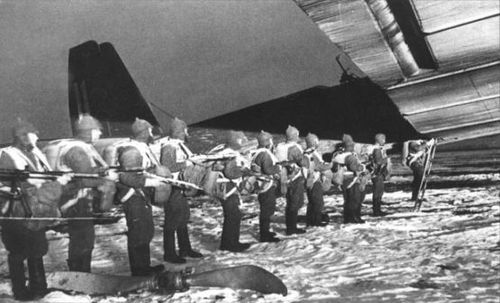
Expansion Plans: 1932
By 1932, Soviet planners aimed to move beyond experimental formations. It was planned to deploy three “aviamotorized airborne detachments” with a total strength of up to 500 personnel.
These units were intended to be:
More standardized in structure
Equipped for limited independent operations
Capable of rapid deployment by air and immediate combat upon landing
This marked the transition from experimentation to institutional development.
The Kyiv Military District Exercises of 1935
A landmark moment in airborne history occurred in 1935, during exercises in the Kyiv Military District. For the first time in the world, the Red Army demonstrated the simultaneous airborne deployment of approximately 1,700 troops.
Even more striking was the successful landing of light amphibious tanks T-37, delivered by air. This operation underscored the Soviet commitment to large-scale airborne operations and shocked foreign military observers, many of whom would later adopt similar concepts.
The exercises proved that airborne forces could operate not merely as light infantry, but as a combined-arms element capable of supporting mechanized warfare.

Organizational Reforms: The Brigade Structure
In 1938, Soviet airborne units transitioned to a brigade-based structure. At the same time, airborne forces were removed from the direct subordination of the Air Force and placed under the command of Ground Forces.
This change reflected a clear doctrinal conclusion: airborne troops were not aviation assets, but a form of maneuver infantry designed for ground combat after landing.
The brigade structure provided:
Greater autonomy
Improved command and control
Enhanced logistical and combat capabilities

Armament and Equipment Before the War
On the eve of the Soviet–German war in 1941, airborne units were among the best-equipped infantry formations in the Red Army. Their armament included advanced small arms such as:
PPD-40 and PPSh submachine guns
SVT-38, SVT-40, and AVT-40 semi-automatic rifles
Mosin–Nagant carbines
ROKS flamethrowers
This emphasis on automatic and semi-automatic weapons reflected the expectation that airborne troops would fight isolated, often surrounded, and required high firepower at the small-unit level.

Toward a Corps Structure
Before the outbreak of war, Soviet military planners intended to reorganize airborne forces into a corps-level command structure, reflecting their growing size and strategic importance. Although this transformation was interrupted by the German invasion, it demonstrated how far Soviet airborne doctrine had advanced in little more than a decade.
Between 1928 and 1941, the Soviet Union laid the foundations of one of the world’s first and most ambitious airborne forces. Through experimentation, foreign technology acquisition, large-scale exercises, and doctrinal innovation, the Red Army transformed parachuting from an aviation novelty into a core element of modern warfare.
These early developments would profoundly influence not only Soviet military operations during the Second World War, but also the global evolution of airborne forces in the decades that followed.


This is a useful discussion for anyone interested in WiFi access, connectivity, and network management. Having reliable information can make it easier to understand different internet access systems and their settings. Readers researching piso wifi may also find additional networking guidance helpful for learning the basics.
Really interesting breakdown of how the Soviet Airborne Forces evolved from early experiments into a structured military doctrine — the shift from improvisation to large-scale strategy is especially impressive. When I take a break from reading these kinds of detailed historical pieces, I usually jump into Subway Surfers City since its fast-paced, endless running gameplay is a simple way to reset my focus for a few minutes.