
Common myths and misconceptions about the War in Bosnia

The war in Bosnia, like many major historical events, remains closely associated with a wide range of myths, misconceptions, and oversimplifications. In this article, we will examine 3 of the most common narratives surrounding the conflict and compare them with the historical evidence.
The war in Bosnia was not fought by real armies, but by gangs and militias
This is arguably one of the most widespread misconceptions about the Bosnian War. It stems largely from the often chaotic and superficial media coverage of the conflict during the 1990s, the relative scarcity of high-quality English-language literature on the subject, and the influence of films and popular culture products that frequently prioritize dramatic storytelling over historical accuracy. While irregular formations, paramilitary groups, and local militias certainly played a significant role, particularly during the early phases of the conflict, the war was primarily fought by organized military forces.
The main belligerents fielded structured armies with formal chains of command, territorial organization, logistical networks, intelligence services, artillery units, armored formations, airforces (to some extent) and operational planning capabilities comparable to those of many conventional armed forces. The conflict involved 3, and after 1993, 4 principal military organizations: the Army of the Republic of Bosnia and Herzegovina (ARBiH), the Army of Republika Srpska (VRS), the Croatian Defence Council (HVO) and the People's Defence of Western Bosnia (NOZB). Each possessed a defined command structure, operational headquarters, brigade- and corps-level formations, and increasingly sophisticated military capabilities as the war progressed.
Although paramilitary groups such as Arkan's Serbian Volunteer Guard, the White Eagles, and various local formations gained considerable media attention due to their involvement in atrocities and ethnic cleansing campaigns, they represented only one component of a much broader military landscape. Their prominence in news reports often created the misleading impression that the conflict was fought primarily by irregular forces. In reality, most major operations were conducted by conventional military formations under centralized command. By the final stages of the war, all major parties were deploying forces that closely resembled regular armies rather than loosely organized militias. Describing the Bosnian War as a conflict fought by “gangs” therefore obscures its true nature.

The Bosnian War was nothing more than a regional conflict
Another common misconception is that the Bosnian War was merely a local conflict fought between neighboring communities. In reality, the war quickly acquired a significant international dimension. The collapse of Yugoslavia attracted the attention and involvement of numerous foreign actors, while all sides sought support beyond Bosnia's borders. The conflict was fueled by extensive arms smuggling networks that developed in response to the UN arms embargo, creating a vast black market that supplied weapons to all belligerents. Bosnia and Herzegovina, in particular, received financial and military support from several Islamic countries, including Iran, Saudi Arabia, and other Middle Eastern states.
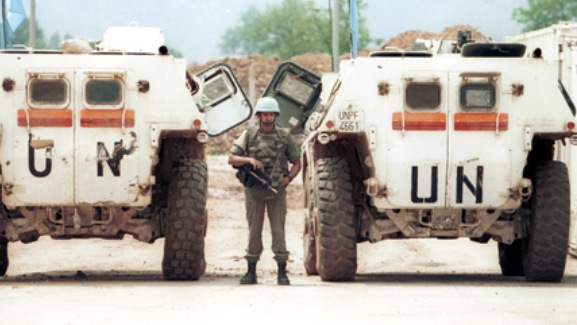
Hundreds of foreign volunteers, commonly known as "mujahideen", also arrived to fight alongside the Army of the Republic of Bosnia and Herzegovina (ARBiH). At the same time, foreign volunteers from Russia, Greece, Romania, and other countries fought alongside Bosnian Serb forces, while Croatia provided direct military, logistical, and political support to Bosnian Croat formations. The war also saw the involvement of the United Nations through UNPROFOR and eventually NATO, which conducted military operations against Bosnian Serb positions in 1994 and 1995. Far from being an isolated regional conflict, the Bosnian War became one of the first major international crises of the post-Cold War era, drawing in states, organizations, volunteers, and resources from across Europe, the Middle East, and beyond.
The main events of the war were the Siege of Sarajevo and the Srebrenica massacre
The Siege of Sarajevo and the Srebrenica massacre are undoubtedly among the most significant and tragic events of the Bosnian War. However, reducing the entire conflict to these 2 episodes overlooks much of its complexity and many other decisive military, political, and humanitarian developments. The war affected virtually every region of Bosnia and Herzegovina and involved numerous major operations, sieges, and campaigns. The Bihać Pocket, for example, remained under siege for more than 3 years and was the scene of some of the fiercest fighting of the war. Large-scale operations such as Operation Corridor 92, Operation Winter '94, Operation Storm, and Operation Sana 95 played a crucial role in shaping the military balance and ultimately influencing the outcome of the conflict. Similarly, ethnic cleansing, massacres, detention camps, and the displacement of civilians occurred across the country, from Prijedor and Foča to Mostar, Tuzla, and countless smaller communities.
Atrocities and violations of international humanitarian law were committed by all sides during the conflict, although with significant differences in scale, systematic character, and political objectives. The destruction of cultural and religious heritage, including the demolition of the Old Bridge of Mostar, also represented a defining aspect of the conflict. While Sarajevo and Srebrenica remain central to understanding the human cost of the war, focusing exclusively on these events risks obscuring the broader military, political, and humanitarian dimensions of a conflict that involved millions of people and transformed the future of the Balkans.


The focus on how superficial media coverage shaped persistent myths is especially important—historical nuance often gets lost in simplified narratives. I’ve been using https://editvideo.pro
The focus on how chaotic, superficial media coverage helped shape myths about the Bosnian War is especially important. I’ve been using an archive that compares wartime narratives with primary sources. https://image-to-3d.online
The focus on how superficial media coverage shaped myths about the Bosnian War is especially important. Comparing those narratives with historical evidence makes the discussion much more useful—I've been using https://mixpost.pro/mixpost-review
The focus on how chaotic media coverage shaped common myths is especially important—simplified narratives still influence how the Bosnian War is discussed today. I’ve been using https://trendtrack.online
The focus on media-driven misconceptions is especially important, since simplified coverage still shapes how many people understand the Bosnian War. I’ve been using https://titlegenerator.online/title-generator-for-youtube