
AK-TK vs AK-RMO (KM-AK): How Ukraine and Russia Modernized Their Soviet AK Rifles

Updated: Aug 26
Following the collapse of the Soviet Union in 1991, the newly independent states inherited enormous stockpiles of Soviet military equipment. Among the most numerous items were Kalashnikov assault rifles of various models, including the AKM, AKMS, AK-74, and AKS-74. Produced in the millions during the Cold War, these rifles remained the standard small arms of most post-Soviet armed forces, security services, and law enforcement agencies.
By the early 2000s, military planners faced a difficult question. While the Kalashnikov platform remained renowned for its reliability, durability, and simplicity, its design reflected the requirements of a different era. Most Soviet-era rifles lacked provisions for modern optical sights, tactical lights, laser aiming devices, vertical foregrips, and other accessories that had become standard equipment on contemporary infantry weapons. In addition, the fixed stock configurations and limited ergonomics of traditional Kalashnikov variants increasingly lagged behind modern battlefield requirements.
Replacing millions of serviceable rifles with entirely new weapon systems would have imposed a significant financial burden on post-Soviet states, many of which faced limited defense budgets and large existing inventories of small arms. As a result, several countries explored an alternative approach: modernizing existing Kalashnikov rifles through upgrade packages designed to improve ergonomics, modularity, and combat effectiveness while retaining the proven reliability of the original weapon.
Ukraine was no exception. During the 2000s and 2010s, Ukrainian defense companies developed a number of modernization programs intended to extend the service life of Soviet-made assault rifles and adapt them to the requirements of modern warfare. Among the most notable were the AK-TK modernisation package developed by the state-owned enterprise Fort and the KM-AK (AK-RMO) upgrade kit offered by the Kalashnikov Concern. Although both systems pursued similar objectives, they reflected different approaches to upgrading one of the world's most iconic military rifles.

AK-TK: The Ukrainian Approach
The outbreak of the War in Donbas in 2014 exposed a number of shortcomings in the small arms inventory of the Ukrainian Armed Forces. Although Soviet-designed Kalashnikov rifles remained reliable and widely available, combat operations revealed the growing importance of modern optics, aiming devices, tactical lights, and improved weapon ergonomics. Ukrainian soldiers frequently found themselves facing adversaries equipped with modernized rifles featuring accessory rails and optical sights, while many Ukrainian servicemen continued to rely on standard AK-74 and AKS-74 rifles configured largely as they had been during the Soviet era.
Recognizing the need for a cost-effective modernization program, the Ukrainian state-owned enterprise Fort began developing a universal upgrade package designed to enhance the combat effectiveness of existing Kalashnikov rifles without requiring the purchase of entirely new weapon systems. The result was the AK-TK modernization kit, a comprehensive upgrade package intended for the vast inventory of Soviet-made AK-74, AKS-74, and AKM rifles still in service with Ukrainian military and security forces.
By 2016, the first prototype and pre-production of army AK-TK kits (first models were presented in 2007 for UA police) had entered field evaluation. Experimental rifles equipped with the new modernization package were issued to Ukrainian military units deployed to the Anti-Terrorist Operation (ATO) zone in eastern Ukraine. According to contemporary reports, airborne and airmobile formations were among the first units selected to test the upgraded rifles under real combat conditions. This approach allowed engineers and military specialists to gather direct feedback from frontline soldiers operating in trenches, urban environments, and mobile combat patrols.


The AK-TK package was designed around a simple principle: preserve the proven reliability of the Kalashnikov system while introducing the modular features expected of a modern infantry weapon. The modernization kit typically included a redesigned handguard equipped with Picatinny rails, a railed gas tube cover, an improved pistol grip, a telescopic adjustable buttstock, and provisions for mounting optical sights, night vision devices, laser designators, foregrips, and tactical flashlights. These modifications significantly improved the rifle's adaptability while requiring only minimal changes to the original weapon.
One of the key advantages of the AK-TK concept was its cost-effectiveness. Rather than replacing thousands of serviceable rifles, the Ukrainian military could modernize existing weapons using domestically produced components. This approach was particularly attractive during a period when defense resources were focused on rapidly expanding and equipping the armed forces. The upgrade package also reduced dependence on foreign suppliers while supporting Ukraine's domestic defense industry.
Field testing in the Donbas conflict provided valuable operational data. Soldiers reported improved weapon handling, greater flexibility in mounting optics, and enhanced effectiveness during low-light operations. The ability to equip standard Kalashnikov rifles with modern accessories represented a significant step toward bringing Soviet-era small arms into line with contemporary battlefield requirements. Although the AK-TK package did not fundamentally alter the operating mechanism of the rifle, it demonstrated how a relatively simple modernization program could substantially improve the practical combat capabilities of existing weapons.
The AK-TK became part of a broader effort by Ukraine to modernize its inherited Soviet military equipment while adapting to the realities of twenty-first-century warfare. In many respects, the project reflected a pragmatic philosophy: rather than replacing the Kalashnikov, Ukrainian engineers sought to evolve it into a more versatile and effective platform capable of meeting the demands of modern combat.
The most comprehensive version of the modernization package was designated AK-TK-9, with the number referring to the nine principal components replaced or upgraded on the host weapon. Unlike many Western modernization programs that focused primarily on accessory rails, the Ukrainian approach sought to improve nearly every major point of interaction between the soldier and the rifle.

The AK-TK-9 package included a redesigned muzzle brake-compensator, a modernized handguard, an upgraded gas tube cover, modern front grip, an ergonomic pistol grip, an adjustable telescopic stock, a magazine guide, a reinforced receiver cover, and an improved fire selector lever. Together, these modifications significantly improved weapon handling, ergonomics, and adaptability while preserving the original operating mechanism and reliability of the Kalashnikov platform.


Particular attention was paid to improving the shooter's ability to operate the rifle under combat conditions. The enlarged selector lever and charging handle extension made weapon manipulation easier while wearing gloves or operating under stress. The magazine guide accelerated reloads by helping the shooter align the magazine with the magazine well, a feature commonly found on modern competition and tactical rifles but rarely seen on traditional Kalashnikov variants.


The redesigned receiver cover served as one of the most important elements of the modernization package. Unlike the standard AK dust cover, which offered no provision for mounting optics, the upgraded component provided a stable platform for modern sighting systems. Combined with the improved handguard and gas tube cover, the rifle could be configured with a wide variety of accessories depending on mission requirements.


Although not officially included among the nine components that gave the system its AK-TK-9 designation, two additional elements were commonly associated with the modernization package. The first was the Israeli-made Meprolight MEPRO M5 reflex sight, which significantly improved target acquisition speed and effectiveness in close-quarters engagements. The second was a recoil buffer installed on the recoil spring guide rod. While relatively simple in design, the buffer was intended to reduce the impact of the bolt carrier group during cycling, potentially improving shooter comfort and reducing wear on the weapon during prolonged use.


Taken together, these modifications transformed a standard Soviet-era AK-74 or AKM into a significantly more modern fighting rifle. Rather than developing an entirely new weapon, Ukrainian engineers focused on maximizing the combat potential of existing firearms through a carefully selected combination of ergonomic, tactical, and functional improvements. The result was a modernization package that addressed many of the shortcomings identified during the early years of the conflict in eastern Ukraine while remaining relatively affordable and easy to implement across large numbers of service rifles.
As development of the AK-TK system progressed, several variations of the modernization package emerged to accommodate the diverse range of Kalashnikov rifles still in Ukrainian service. This flexibility became one of the project's key advantages, allowing the upgrade kit to be adapted to both fixed-stock and folding-stock weapons without requiring extensive modifications to the rifle's receiver.


For rifles equipped with side-folding stocks, such as the AKS-74 and AKMS, Fort engineers developed a specialized folding stock assembly mounted on a robust hinge mechanism. The design preserved the original compact dimensions of the weapon during transport while providing significantly improved ergonomics compared to the standard Soviet stock. This configuration proved particularly attractive for airborne troops, reconnaissance units, vehicle crews, and special operations personnel, all of whom frequently operated in confined spaces where a compact weapon was advantageous.
For standard infantry rifles such as the AK-74, a different approach was adopted. The original fixed wooden or polymer stock could be removed and replaced with a modern telescopic buttstock assembly without major alterations to the weapon. This solution provided soldiers with an adjustable length of pull, allowing the rifle to be tailored to individual preferences, body armor configurations, and seasonal clothing. Such adaptability represented a significant improvement over the fixed dimensions of the original Soviet design.

The modular nature of the AK-TK program meant that units could select configurations best suited to their operational requirements. Air assault and special-purpose troops often favored folding-stock variants optimized for mobility, while conventional infantry units generally employed rifles fitted with telescopic stocks that prioritized comfort and shooting stability. In both cases, the modernization package preserved the core reliability of the Kalashnikov system while introducing a level of ergonomics and customization previously unavailable on standard service rifles.
This adaptability reflected one of the central goals of the AK-TK project: creating a modernization package capable of extending the service life of thousands of Soviet-era rifles while accommodating the differing needs of modern Ukrainian military formations. Rather than imposing a single configuration across the entire force, the system allowed existing weapons to be tailored to specific missions and user preferences, bringing the venerable Kalashnikov platform closer to contemporary Western standards of modularity.

Beginning in 2016, AK-TK modernization kits gradually entered service with various Ukrainian military and security organizations. Small batches were issued to units of the Ukrainian Armed Forces, particularly mechanized brigades and Air Assault Forces (DShV), as well as formations of the Ministry of Internal Affairs, the Main Directorate of Intelligence (HUR), and the Special Operations Forces (SSO). Among all users, the Air Assault Forces became the most prominent operators of the upgraded rifles, with AK-TK-equipped weapons frequently appearing in official photographs, military exercises, and operational deployments.


Despite its innovative approach, the AK-TK modernization package never achieved truly widespread adoption. While the system successfully addressed many of the shortcomings of Soviet-era Kalashnikov rifles, it also introduced several compromises. One of the most commonly cited concerns was the increased overall weight of the weapon once the modernization package, optical sight, and additional accessories were installed. Some users also reported concerns regarding the long-term durability and reliability of certain folding-stock adapter assemblies, particularly under intensive field use.

Nevertheless, the AK-TK was far more than a parade or exhibition rifle. The system was tested under real combat conditions during the Anti-Terrorist Operation (ATO) and later saw continued service during the Joint Forces Operation (JFO) in eastern Ukraine. Following Russia's full-scale invasion in February 2022, many AK-TK-equipped rifles remained in frontline service, where they continued to be used by Ukrainian military personnel alongside a growing variety of domestically produced and foreign-supplied small arms.

By 2024, modernization kits were still being produced and could occasionally be observed in active service. However, their role had gradually diminished as increasing numbers of Western-designed rifles and modern weapon systems entered Ukrainian military inventories. The widespread availability of platforms designed from the outset for modular accessories reduced the need for extensive upgrades to legacy Kalashnikov rifles.

Even so, the AK-TK occupies a unique place in the history of Ukraine's defense industry. Developed during a critical period of military transformation, it represented one of the first serious domestic attempts to adapt inherited Soviet small arms to the realities of modern warfare. While its operational relevance may be gradually fading, the AK-TK remains an important milestone in the evolution of Ukrainian military small arms and a noteworthy chapter in the country's contemporary weapons-development history.
AK-RMO (KM-AK): The Russian Modernization Concept
The origins of the KM-AK modernization package can likely be traced back to the early stages of Russia's next-generation soldier equipment programs in the late 2000s and early 2010s. One of the earliest publicly known appearances of the system occurred during the comparative testing of the competing Permyachka and Ratnik soldier modernization programs around 2011. At the time, Russian military planners were searching for ways to improve the effectiveness of individual soldiers while avoiding the enormous expense associated with replacing millions of existing Kalashnikov rifles.

The earliest version of the modernization kit differed noticeably from the configuration that would later become widely known as the KM-AK. Prototype rifles displayed during the 2011 testing phase retained many features of the standard AK-74M. The weapon still utilized the original AK-74M polymer handguard with only limited modifications, the standard 30-round AK-74 magazine, and the traditional AK-74 muzzle brake-compensator. At this stage, the modernization effort was focused primarily on improving accessory mounting options rather than fundamentally altering the rifle's ergonomics.

Perhaps the most obvious difference between the early prototype and later production versions was the absence of a telescopic stock. The rifle retained a stock closely resembling the standard side-folding polymer stock of the AK-74M, reflecting the conservative nature of the initial modernization effort. Russian designers appeared determined to preserve as many existing components as possible while gradually introducing features required by the emerging Ratnik soldier system.
Even in this early form, however, several characteristics of the future KM-AK concept were already visible. The weapon featured revised mounting solutions for optical sights and accessories, demonstrating a growing recognition that modern infantry combat increasingly relied upon optics, night-vision devices, laser aiming systems, and tactical illumination equipment. Rather than creating an entirely new rifle, the objective was to evolve the proven Kalashnikov platform into a more modular and adaptable weapon system.

The lessons learned during the Permyachka and Ratnik trials would ultimately shape the final configuration of the KM-AK modernization kit. Over the following years, the system evolved considerably, incorporating a redesigned handguard, improved receiver cover, ergonomic controls, a telescopic stock, and numerous other enhancements that would eventually form the basis of the Russian Army's broader Kalashnikov modernization efforts.

Although both modernization programs sought to bring the Kalashnikov platform into the modern era, the AK-TK and AK-RMO reflected different operational requirements, industrial capabilities, and military priorities. The Ukrainian system emerged directly from combat experience gained during the war in Donbas, while the Russian program was driven largely by the requirements of the Ratnik soldier modernization initiative and the need to standardize equipment across the Russian Armed Forces.

A comparison of the two systems offers a fascinating insight into how two successor states of the Soviet Union attempted to solve the same problem using different approaches, while remaining faithful to one of the most successful military rifle designs ever created.

The development of the AK-RMO modernization kit was closely linked to the broader Ratnik soldier modernization program and the uncertain future of the early AK-12 project. During the early 2010s, the Kalashnikov Concern was actively promoting the first-generation AK-12, a rifle that incorporated numerous design changes intended to bring the Kalashnikov platform into the twenty-first century. However, the weapon was still undergoing extensive testing and refinement, while military officials and industry representatives sought ways to reduce both production costs and technical complexity.


Although innovative, the 2011–2012 version of the AK-12 introduced a number of features that complicated its potential mass adoption. One of the most controversial additions was a bolt hold-open mechanism, which required specially designed magazines to function correctly. This immediately created logistical concerns, as the Russian Armed Forces possessed millions of standard AK-74 and AK-74M magazines accumulated over decades of service. Introducing a new magazine standard would significantly increase procurement costs and complicate supply chains throughout the military.

The issue extended beyond magazines alone. By the beginning of the Ratnik program, the Russian military had already invested heavily in optical sights, night-vision devices, and training systems developed around the ballistic characteristics of the 5.45×39 mm AK-74 family. Vast stockpiles of optics were calibrated specifically for the trajectory of the standard AK-74 cartridge fired from conventional service rifles. Any significant departure from the established weapon system risked creating additional logistical and training challenges at a time when military planners were seeking affordable and practical modernization solutions.

Against this backdrop, the AK-RMO emerged as a highly attractive alternative. Rather than replacing the AK-74M with an entirely new rifle, the modernization kit retained the proven operating system, existing magazines, spare parts inventory, maintenance procedures, and established training doctrine. From the perspective of military procurement officials, this approach offered many of the benefits associated with the AK-12 while avoiding much of the financial and logistical burden involved in introducing a completely new weapon.

In many respects, the AK-RMO represented a conservative but pragmatic solution. It provided modern accessory mounting options, improved ergonomics, and compatibility with the Ratnik equipment suite while maintaining nearly complete commonality with existing service rifles. This allowed the Russian military to modernize large numbers of weapons rapidly and at relatively low cost while the future of the AK-12 remained uncertain.


The influence of the AK-RMO program would ultimately extend beyond its role as a simple modernization package. Many of the lessons learned during its development would later influence the redesign of the AK-12 itself, contributing to the simplified and more conventional configuration eventually adopted by the Russian Armed Forces.


The story of the KM-AK (AK-RMO) modernization program effectively began to draw to a close following the adoption of the final production version of the AK-12 by the Russian Armed Forces in 2018. Originally conceived as an interim solution for modernizing the vast inventory of existing AK-74M rifles, the KM-AK package had fulfilled its primary purpose: bridging the gap between Soviet-era small arms and a new generation of modular assault rifles.
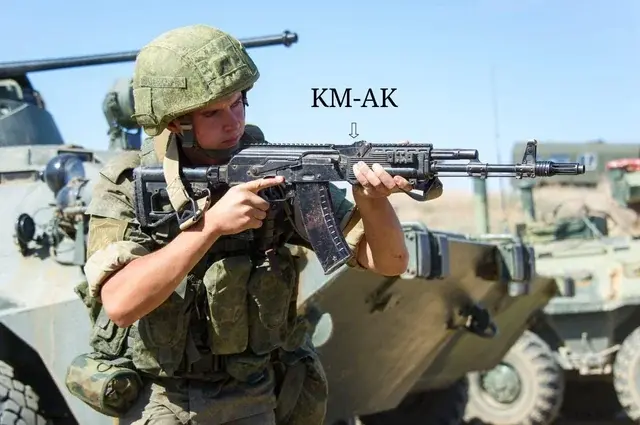
Once the AK-12 entered large-scale production and procurement, the Russian military gradually shifted its focus toward re-equipping frontline units with newly manufactured weapons rather than upgrading older rifles. As a result, demand for additional KM-AK modernization kits declined significantly. Although upgraded rifles continued to serve alongside newer weapons, the modernization package was no longer viewed as a long-term solution for the future development of Russian infantry small arms.

Despite its transitional nature, the KM-AK system accumulated considerable operational experience. Rifles equipped with elements of the modernization package were observed during Russian military operations in Syria, where they provided valuable feedback under combat conditions. Later, upgraded AK-74M rifles incorporating KM-AK components also appeared during Russia's full-scale invasion of Ukraine, often serving alongside newer AK-12 rifles in frontline formations.


By the early 2020s, the KM-AK had become something of a transitional weapon system—a product of a period when military planners sought to extract additional combat value from existing Kalashnikov inventories while waiting for the arrival of an entirely new service rifle. Although examples remain in service and can still occasionally be encountered among regular and reserve units, the modernization program has largely been overshadowed by the widespread introduction of newer weapon systems.
In many respects, the fate of the KM-AK mirrors that of Ukraine's AK-TK modernization project. Both programs emerged from the same fundamental challenge faced by post-Soviet militaries: how to adapt millions of reliable but aging Kalashnikov rifles to the realities of twenty-first-century warfare. Both demonstrated that modernization could significantly improve the combat effectiveness of legacy weapons without requiring complete replacement. Yet both were ultimately transitional solutions, gradually giving way to newer rifle platforms designed from the outset for modular accessories, advanced optics, and modern battlefield requirements.

Today, the KM-AK remains an interesting chapter in the continuing evolution of the Kalashnikov system. While its era may be drawing to a close, it serves as a reminder of how military engineers in Russia sought to extend the operational relevance of one of the world's most iconic assault rifles during a period of rapid technological change.


The comparison of Ukraine’s AK-TK with Russia’s AK-RMO shows how differently the same Soviet rifle legacy can evolve. The distinction between modernization goals is especially interesting—I've been using https://veedai.pro
NEAL.fun brings together creative online games, interactive simulations, educational visualizations, and unusual online experiments. Each project offers a different experience. You can explore the depths of the ocean, compare the size of living things, spend the fortune of billionaires, create new elements, draw your own constellation, or try to create an almost impossible password.
Valhalla Vitality offers a broad selection of information for people interested in wellness and men's health. The platform discusses different areas rather than focusing on just one type of treatment or concern. I like that the information is relatively easy to navigate. Overall, it is worth exploring if you want to learn more about current wellness approaches.
https://valhallavitality.com/
Gracias por compartir un contenido tan sencillo de comprender. La estructura facilita bastante la lectura y permite localizar los puntos principales. Para quienes buscan información sobre la lotería nacional, disponer de datos claros puede hacer que la consulta resulte mucho más práctica.
Whether you enjoy solving creative puzzles or experimenting with new ideas, Infinite Craft provides an addictive experience filled with limitless combinations.