
The Last RPK Russia Will Ever Design - The Full Story of the RPK-16 (PART 1)

Updated: Dec 14, 2025

This article has been adapted from the following linked video by Heval, the original author, and admin of the Rosenritter YouTube channel, for the pleasure of those who prefer to read.
The Last RPK Russia Will Ever Design - The Full Story of the RPK-16 (PART 1):
The RPK-16, the 6P70 AK-12’s bigger brother, indeed saw combat across the world in the hands of Russian Spetsnaz forces. First, there was the official Ministry of Defense test and evaluation, including in the chaotic Syrian Civil War, as Russian forces worked to secure and prop up the battered Ba’athist regime. After that, the weapon has witnessed the full-scale invasion of Ukraine after remaining in select Spetsnaz brigade arsenals, which Kalashnikov Concern’s own specialist representatives at the front have kept tabs on. Even, famously, in the hit video game Escape From Tarkov, a former athlete madman, donning a Maska helmet and three-striped tracksuit, would use his favored RPK-16 to terrorize the formerly EMERCOM-commandeered ULTRA shopping mall in the closed-off Norvinsk region.
Despite all of this, it was the "Light Support Weapon" concept’s last hurrah for Russia. That concept would become officially forgotten with the beginning of the RPL-20’s fielding with VDV forces in Eastern Ukraine. Even though the Soviet army were the ones that originally pioneered the concept with the original 7.62x39mm RPK and 5.45x39mm RPK-74.

For their own part, Kalashnikov Concern (formerly Izhmash) and Vyatskiye Polyany Molot did not completely slack with the development of this new, exclusively mag-fed machine gun. In 2015, it started against the backdrop of the “Tokar” programs and the later “Kipchak” program’s RPK-400 to complement the rescue effort of the Ministry of Defense’s “Ratnik” program by the AK-400, which would later become the adopted AK-12.

Feature set
At the heart of the gun is the classic Kalashnikov system– A long-stroke piston system, with a rotating lugged bolt, sitting in a stamped receiver. The receiver itself is of the spec of an RPK-74M. The sheet metal is 1.5mm thick compared to the 1mm thickness of the standard AK, and surrounds a bulged front trunnion. The rear trunnion has the folding stock mechanism that was the mainline standard since the AK-100 series. The railed receiver cover was essentially the same, entirely detachable cover as the “Type 1” AK-12. The retention pin for it in the front trunnion differed from the AK-12 and throughout the RPK-16’s lifetime. Its performance at holding a zero, compared to the AK-12, isn’t quite as well-known.

One of the more unique features of the RPK-16 was its “easy-change” barrel system. A dovetail clamp, torqued down by a large screw, would secure the barrel to the trunnion it slid into. This system wasn’t meant for swapping out an overheated barrel in the field, despite how desirable that is for a suppressive fire weapon. Instead, it was intended to ease the maintenance and logistical burden of the weapon, as it was expected to achieve a high round count. [1][2]

To complement the easy-change barrel system were two modular options in barrel lengths: 590mm (23.2 inches) as standard for the RPK, and the AK’s standard of 415mm (16.3 inches). [1] Both featured hefty and tampered profiles to serve as heatsinks. The flash hider would differ a bit throughout the weapon’s life. At first, it simply boasted a birdcage design. Later, and most typically seen, was a thick three-pronged design, compatible with a proprietary suppressor.
The all-polymer handguard follows the eventual philosophy of the adopted AK-12. It was pinned in the barrel around the chamber end and covered up the barrel clamp. Like the AK-12 handguard, removal was easy and simply required a flat spring to be depressed via a tiny pinhole in order to remove the main pin. [1] The handguard made the design trade-off of being lightweight and easily free-floated from the barrel. The latter meant pressure against the handguard, such as from a bipod, couldn’t cause a point-of-impact shift. However, this came at the downside of the handguard itself, lacking the rigidity to be ideal for maintaining the zero of mounted laser aiming modules.

The rest of the furniture matches the “Type 1” AK-12. Inside the pistol grip, releasable by a round button, is the cleaning kit, with the cleaning rod broken down. The length-of-pull adjustable stock emulates an AR’s stock and buffer tube; however, it’s completely incompatible and, as previously mentioned, folding. The selector is also the same as the “Type 1” AK-12 with a thumb “shelf” but only three positions– safe, semi, and full.
The front sight and gas block became a combo to roughly match the AK-12, for the sake of cost and simplicity, and it was included in the gas tube’s setup. The windage-adjustable rear iron was moved as far back as possible to increase sight radius and to act as a diopter sight for more precise shooting. The front iron sight, sliding in a dovetail cut, was also windage-adjustable to accommodate zeroing of the modular barrels.

The magazines included with the RPK-16 were the standard AK-12 6L23.01 magazine and the M125, originally M121, 95-round drum. [3] As a machine gun, of course, the drum was supposed to be a critical cornerstone of the kit. The drum was originally developed for the requirements of the “Ratnik” program’s assault rifle and the AK-12, even back to Vladimir Zlobin’s AK-12 prototype. [3] Those features very much fit the bill of an RPK-74 for the 21st century.

What came before.
Now, all these features were simply the words of the thesis that the original RPK laid out. It’s what’s colloquially called the “Light Support Weapon”, or sometimes the “Infantry Automatic Rifleman”, concept in the West. The basic idea is simple: an alternative version of the standard issue rifle of an army, but with modifications to lend itself to spitting as much lead as possible. Typically, this is accomplished with a heavier barrel, bipod, greater capacity magazines, and perhaps other features such as the ability to fire from an open bolt.

Squad-level tactics and modern warfare’s emphasis on mobility always have a hunger for suppressing fire to enable friendly advances, often on the flank, or to simply keep the enemy from advancing. Belt-feds do that the best, but at heavy logistical trade-offs. Compared to an LSW-disciple weapon, they’re more expensive and require exclusive belts, parts, training/familiarization, and often different cartridges to flow down the supply chain. These little things are butterfly wings beating tornadoes for the massive moving machines of an army, especially any Cold War-era army, expected to operate over an entire continent in any given moment. Even within the squad element, it causes complications, as in an emergency, one squad member can’t just simply hand a magazine from his allocation to the oh-so-hungry machine gunner.
Amongst the West, examples of the LSW concept, in service and not, include the L86, the G36MG, the Colt Automatic Rifle, the Marines’ IAR M27 (asterisk aplenty), FN FALO, the Colt IAR, and Aug HBAR. While the Bren, BAR, and ZB-26, using the calibers of the squad’s bolt-action infantry rifles, had an inkling of the concept back in the day, the Soviets were the first to really forge it, and a total logistical unification of calibers. Albeit, the Canadian Armed Forces toyed around with the idea at a similar time, with the FAL-based C2 in 1958. [4]
The Soviets' first step came shortly after WWII with the decision to make every new small arm in their inventory, 7.62x39mm. Their new “sub-machinegun” (the AK-47), standard rifle (the SKS), and the LMG (the RPD) would all follow that decree. Later on, as concern over the Cold War became apparent, the Soviets looked to simplify the logistics of what would remain a large army; therefore, they looked to change that lineup of small arms. From 1956 to 1961, the perfected stamped AKM would be developed to supplant the AK-47 and SKS, and, importantly for our story, the RPK was to replace the RPD. [5][6]

As we have defined the LSW concept, the original RPK matched the AKM in about everything but had a longer, heavier barrel, a reinforced and thicker receiver, a bipod, a clubbed stock for prone shooting, windage-adjustable sights, and other small tweaks. It was also supplied with long 40-round magazines and a 75-round drum. The Vyatskiye Polyany Molot factory, instead of M.T.Kalashnikov’s home plant in Izhevsk (Izhmash), would be in charge of its production. A folding stock version also existed for paratroopers, the RPKS. [5][6]
Later on in 1974, despite the belt-fed 7.62x54R PK now on the stage, the Soviets would still keep the RPK in the switch from 7.62x39 to 5.45x39. Thus, the RPK-74 was born, and came only with long 45-round magazines. It would later receive updated polymer furniture and be made to essentially match the standard of the AK-100 series, and much later, the standard of the AK-200 series. [7]

Separate from Molot’s offerings, Izhmash attempted its own lineup of RPKs in the late 90s with its “RPK-100” series. These guns were based on regular AK-74Ms, including their non-bulged receivers, but in the format of an RPK. This line-up was supposed to pair with their quad-stack magazine experiments at the time and to grab a corner of the export market for the cash-strapped Izhmash factory. Ultimately, the guns didn’t go anywhere, and photos are pretty rare. [8]

In 2013, the FSB would order for a modernized RPK under “Vyuga-11”, one of their V-initialed programs. No proper photos exist of the resulting OTs-81 gun, but internal employee testimony and a render from its manufacturer, TsKIB SOO, is available. The OTs-81 featured upgraded furniture, a dynamic fire-rate, and a suppressor. Alongside it, as a part of the program, were numerous 5.45x39mm drums. These include the 115-round OTs-82 (only 100 rounds in practice) dual-drum, the 70-round OTs–87, and the 75-round OTs-103. The program did apparently see some success, but its results have never left the obscurity of the secretive FSB. [6][9]

Dual Feeds
Now this contrast between a mag-fed LSW and a regular belt-fed LMG raises the question: Why not both? Well, the Soviets asked that question too and tried to answer it during the “Plemyannik” and “Poplin” projects, with both mag-feeding and belt-feeding, PU-1, PU-2, and PU-21 designs. These designs did not go far, however, as the PU-1 and PU-2 saw considerable reliability issues, and the PU-21 didn’t see any real testing, as the Soviet GRAU had lost interest in the very drawn-out program. [10] The later FN Minimi, adopted by the US Army as the M249 SAW, does indeed feature such dual feeding. However, the magazine feeding is, at best, notoriously fickle and unreliable. [11]

From 2011 to later in the decade, the “Tokar” 1 and 2 programs, under the patronage of the Ministry of Internal Affairs of the now Russian Federation, called for more attempts at a dual feeding machine gun. The Degtyarev plant, with its “Kord-5.45” example, would be the most prominent component of this program. [6][12] Kalashnikov Concern may have fielded in the program some machine gun designs, such as the FSB-ordered “Vestern” DRP, potential modifications of the PUs, and other attempts, but any information on these for right now is esoteric and locked behind closed doors. [13][14]

Outside of the program, the Concern took a two-pronged approach to play the game publicly and for the long term. To cover, at least the general need for a modern machine gun in 5.45, they began to develop both an exclusively belt-fed option, the RPL-20, and an exclusively mag-fed option, the RPK-400, later RPK-16. [12]
RPK-400
In the 2010s, the future of Russian small arms was expected of Kalashnikov Concern, formerly Izhmash; however, for those on the inside, the industry giant's future looked bleak at many of those moments. The transformation of the Izhmash factory into the Concern was but one case in a series of life-buoys thrown to them, to keep them afloat amongst internal scandal and bankruptcy scares. One such hope was Vladimir Zlobin, a chief designer at the Concern at the time, who was brought over from Tula. [15] His story is its own rabbit hole, though, and we have covered a sliver of it already with our video and article on his AS-1 rifle.
Nonetheless, in brief, his endeavors never bore fruit in the “Ratnik”, “Warrior” program’s trials. In 2015, politicking afoot, Kalashnikov Concern’s 7.62x39mm submission, led by the KTC, Design and Technology Center, faction of the factory, would be tasked with salvaging the whole effort under a new chief designer, Sergey Urzhumtsev. He was actually the former CEO of the Molot factory and came over to the Concern in the previous year. [15][16][17] The designers, including project lead Dmitry Dolganov, would turn to their previous designs for the “AK-400” and grant it the furniture from the KM-AK upgrade kit (that had been previously developed under the unrelated “Obves” tender). These designs, with further developments, would pass “Ratnik” alongside the Degtyarev plant’s submissions. They would eventually become the “Type 1” AK-12 and AK-15, which were fully adopted in 2018 by the Russian Army. [16][17]


During the early conflict in the Donetsk and Luhansk regions, the Ukrainian’s would call it the “Anti-Terrorist Operation Zone”. Local Donbass militias, starting in 2014, would be organized by FSB-connected personnel such as Igor “Strelok” Girkin, regular Russian army elements, and SSO operatives. The latter specifically would put in an informal request to the Russian industry for a new light support weapon– for a new RPK. [18]

Naturally, this project would fall to the RPK manufacturer, the Molot factory. [18] There, designer Dmitry Michailovich Chuchaev would undertake the development of the prototype that would lead to the RPK-16. Molot would show off the new machine gun in a closed-door demonstration to the Russian military. However, after that meeting, the representatives of Kalashnikov Concern decided to take over the project. Thus, Molot had to relinquish it as the Concern had seen significant political and financial investment by the Russian state at the time. Afterwards, the Molot factory origins of the weapon would fall into obscurity. [19] Chuchaev would go on to found his own firearms company, Rubicon Arms, and design projects such as the multi-caliber RA-15 AR and the civilian PKM-O. [20][21]

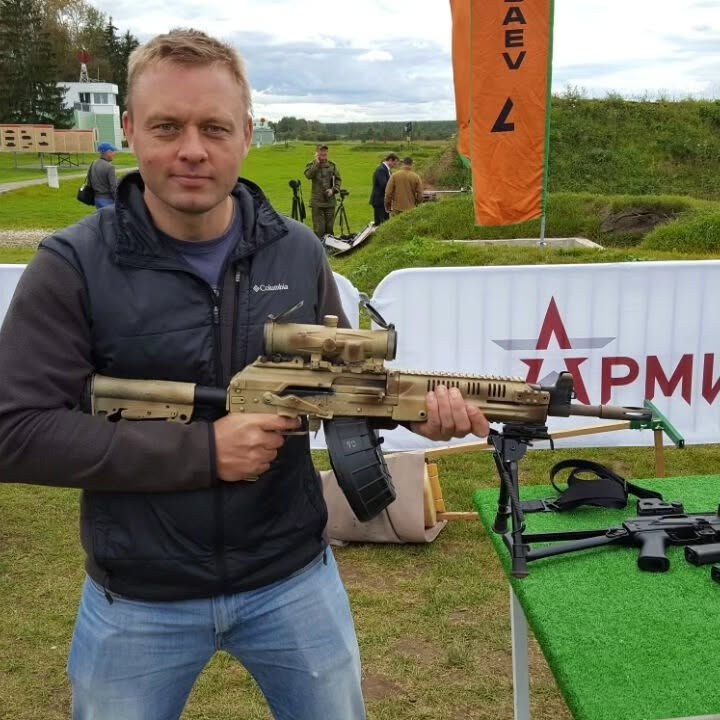
Thus, after all of that, in November 2015, at a special forces competition for the FSKN, the Federal Drug Control Service of Russia, the RPK-400 would be revealed to the world. In the hands of the Concern’s spokesperson at the time, Vladimir Onokoy, the machine gun mostly resembled the later RPK-16s but with some distinct differences. Most noticeable was that it had a different handguard and a different scheme for the free-floating bipod. It bore a birdcage-like flashhider, while the gas block and front trunnion bore some geometry changes. The rear irons were also of a different flip-up diopter design with protective fins. [6][22]

As the RPK was really Molot’s child and not the Izhmash factory’s, Sergey Urzhumtsev would turn to them for some of the manufacturing. Molot-made 1991 RPKS/RPK-74M receivers would be spotted as the basis for many of the early RPK-16 examples. [23] The Concern would even order about 50 barrels from them. [24] At the “Army-2016” exhibition, Kalashnikov Concern had by then bestowed the 400 series with their final product denominations. The “Ratnik” program AK-400 would become the 5.45x39mm AK-12 and the 7.62x39mm AK-15, while the RPK-400 would become the RPK-16, as in 2016, being roughly the year of its coming-of-age. [25]

By this point, the samples at the expo had their features and details mostly unified with their sister AK-12 and what would become the typical RPK-16. However, the short-barrel example that many of the attendees had the chance to shoot still featured a barrel from the RPK-400 and its older gas block and flash hider design. The long-barreled example on display had an updated gas block, suppressor, and an all-polymer stock. This stock, with and without the additional clubbed grip, was featured on the SVK marksman rifle at the same time and was the predecessor mold to what would become the stock on the “Type 2” AK-12 model of 2020 and what’s sold as the “AK-EVO” on the Russian civilian market. The gun would show up in many promotional images and publications from the Concern and Russian media from then on, albeit the “AK-EVO” stock wouldn’t make many more appearances on it.
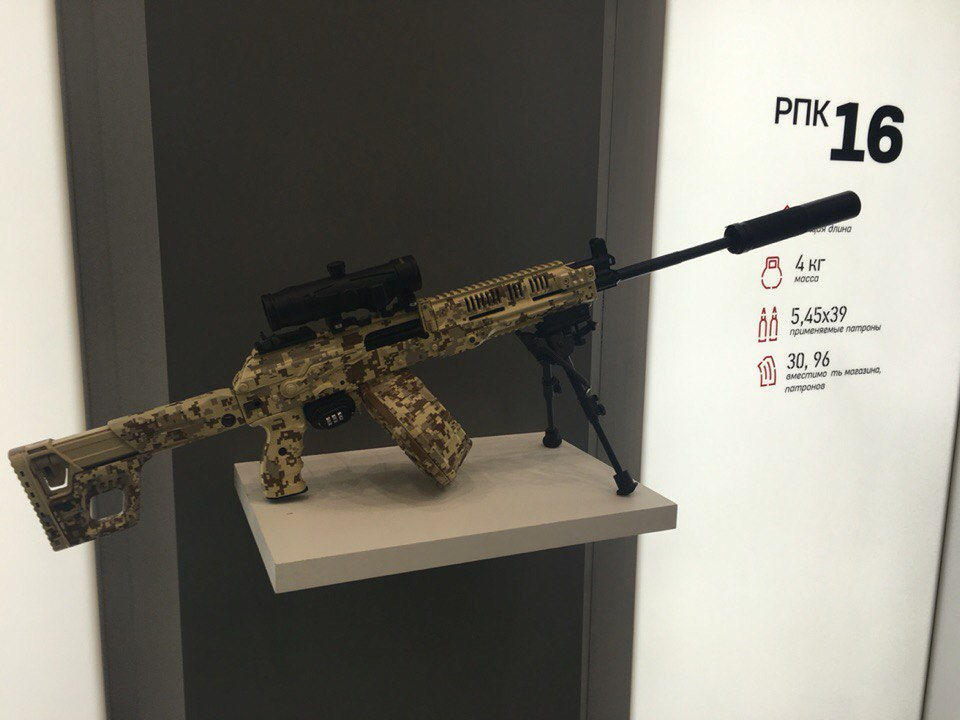
In Part 2, we’ll discuss its operational history and (lack of a real) legacy.
Special Thanks to:
Just Guns - Deni Almashnikov:
TheWarzoneArmorer:
And for the works of Maxim Popenker:
And AK-INFO:
Sources for Parts 1 and 2:
[13]Deni Almashnikov
[29]Deni Almashnikov, https://vk.com/wall-96695355_12631


Comments