
A full list of all Small Arms of the Russian Civil War (1917–1922)

This is a comprehensive list of small arms used during the Russian Civil War (1917–1922). Because the conflict was fought by a staggering array of factions — the Red Army, the White armies, foreign interventionist forces (British, American, French, Japanese, Czech), Cossack hosts, Green armies, Ukrainian Army and regional warlords, the arsenal was extraordinarily diverse, drawing from Imperial Russian stockpiles, Central Powers captured equipment, and Allied-supplied weapons.
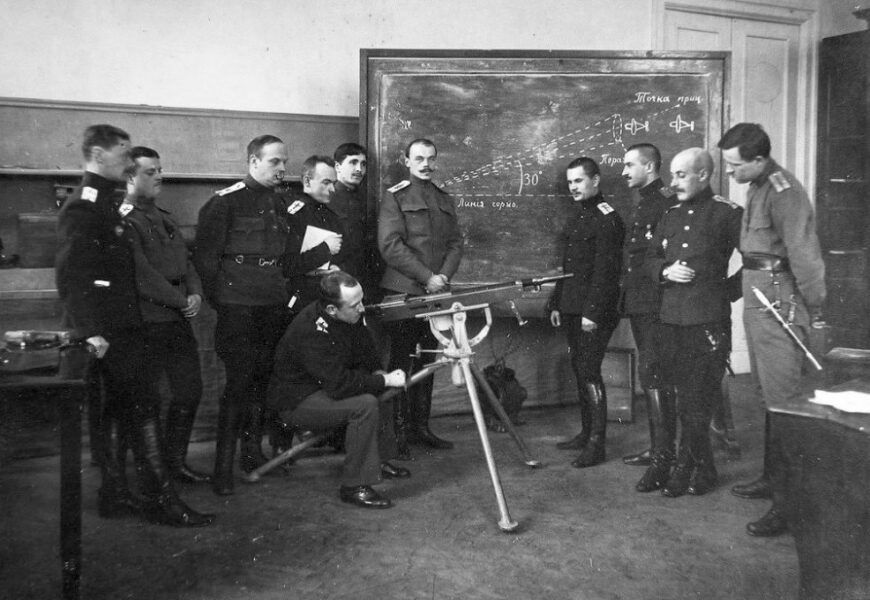
Small Arms of the Russian Civil War (1917–1922)
Pistols & Revolvers
Sidearms in the Russian Civil War were simultaneously status symbols, practical weapons of last resort, and tools of political terror. The Nagant M1895 revolver remained the standard issue handgun for officers and NCOs of all factions. The German Mauser C96 — the iconic broomhandle, achieved near-mythological status on all sides: the short-barrelled "Bolo" variant, purchased by the Soviet state from Weimar Germany, became so associated with Cheka commissars that Westerners named it after the Bolsheviks themselves.

Captured German P08 Lugers circulated widely among officers, while Allied supply lines introduced Colt M1911s and Webley revolvers to White forces. Older arms — the pre-Nagant Smith & Wesson Russian Model, Belgian Brownings privately acquired by Tsarist officers, and French Modèle 1892 revolvers usually appeared in the hands of those who had carried them for years before the revolution.
Nagant M1895 Revolver
Mauser C96 "Broomhandle"
Mauser C96 "Bolo" (Kurz)
German P08 Luger (Pistole 08)
Colt M1911
Browning FN 1903
Browning FN 1900
Smith & Wesson Model 3 (Russian Model)
Modèle 1892 Revolver (French Officer's Revolver)
Webley Mk IV / Mk VI Revolver
Rifles
Rifles formed the backbone of infantry combat across every faction in the Russian Civil War. The Mosin-Nagant M1891 and its variants (the Dragoon, Cossack, and M1907 Carbine) dominated the battlefield as the near-universal standard arm, with tens of millions in circulation. Supplementing these were large stocks of older and foreign weapons accumulated during the desperate arms procurement of the First World War: American Winchester lever-actions, Japanese Arisakas in incompatible calibres, French Lebels and Berthiers, and Italian Vetterlis all appeared in rear-area and irregular units.

Allied intervention brought Lee-Enfields, Ross Rifles, Springfields, and M1917 Enfields to White forces and foreign expeditionary troops in the north and Siberia, while captured Austro-Hungarian Mannlichers added further calibre chaos. On the technical frontier, the remarkable Fedorov Avtomat, chambered in 6.5mm Arisaka and capable of automatic fire, saw limited but operationally significant use, making it arguably the world's first assault rifle in practical service.
Mosin-Nagant M1891 (Infantry Model)
Mosin-Nagant M1891 Dragoon (Cavalry) Model
Mosin-Nagant M1891 Cossack Model
Mosin-Nagant M1907 Carbine
Berdan Rifle No. 2 (Berdan II)
Winchester Model 1895 (Russian Contract)
Arisaka Type 30
Arisaka Type 38
Lebel Modèle 1886 (Mle 1886)
Berthier Rifle (Various Models)
Lee-Enfield (SMLE Mk III / Mk III*)
Ross Rifle (Mk II / Mk III)
Springfield Model 1903
M1917 Enfield (American Enfield)
Mannlicher M1895
Vetterli-Vitali M1870/87
Fedorov Avtomat (M1916)
Machine Guns (Heavy / Medium)
Heavy and medium machine guns defined the tactical landscape of the Civil War, and none more so than the water-cooled PM M1910 Maxim on its distinctive Sokolov wheeled carriage. Mounted on the Tachanka — the horse-drawn cart that became the war's most iconic weapon system, the M1910 was produced in large numbers by the nascent Soviet industrial base and used by all factions.

Its predecessor, the bronze-jacketed PM M1905, soldiered on, albeit in much smaller numbers. German MG08 and MG08/15 weapons, captured from Central Powers stockpiles at the Armistice, equipped Red Army units and Polish and Lithuanian forces alike. Allied intervention brought the British Vickers to White forces in the north, while French Hotchkiss M1914 guns came via Allied supply chains.
PM M1910 (Pulemyot Maxima obr. 1910)
PM M1905
Vickers Machine Gun (Mk I)
MG 08 (Maschinengewehr 08)
MG 08/15
Hotchkiss M1914
Hotchkiss M1909 (Benet-Mercié)
Machine Guns (Light)
Light machine guns gave infantry sections a degree of mobile firepower that shaped small-unit tactics across the war. The British Lewis Gun, with its distinctive circular pan magazine and cooling fins, was the most widely distributed: the Imperial Russian government had purchased 20,000 from British and American sources by 1917, and they appeared on infantry lines, armoured trains, and aircraft alike.

The French Chauchat, the most mass-produced automatic weapon of the First World War, reached Russia in significant numbers and served with whatever units received French war material. The Danish Madsen — widely regarded as the world's first practical light machine gun, had been procured in 7.62 × 54R mm for Russian service and continued in use throughout the conflict. Rounding out the light automatic weapons inventory was the Colt-Browning M1895 and its improved Marlin-Rockwell derivative, nearly 15,000 of which had been acquired before and during the World War.
Lewis Gun (M1914 / M1915)
Chauchat (CSRG Mle 1915)
Madsen Machine Gun (M1902)
Colt-Browning M1895 / Marlin Rockwell M1895/1914 ("Potato Digger")
NOTES ON CONTEXT
The Russian Civil War was, as one source put it, a truly "international" affair, with small arms from around the globe used in significant numbers. For the most part, foreign armies typically carried their own firearms, while the Bolshevik Red Army and anti-Bolshevik Whites relied largely on Russian military small arms.

Supply was chaotic and uneven throughout. One infantry regiment was documented as having weapons in 10 different calibres — a logistical nightmare that affected all factions at various points. The Tachanka (a horse-drawn cart mounting a Maxim PM M1910) became the iconic fighting platform of the war, allowing machine guns the mobility to keep pace with the cavalry-heavy, fast-moving warfare that characterised the vast open steppes. Cavalry and Cossack forces additionally relied heavily on the sabre and lance for close-quarters shock action. The war was as much defined by improvisation and scarcity as by any standardised doctrine of arms.


The mix of Imperial stockpiles, Central Powers captures, and foreign interventionist weapons really shows how fragmented the conflict was. I’ve been using https://veedai.pro
The mix of Imperial stockpiles, captured Central Powers weapons, and foreign interventionist arms really shows how fragmented the conflict was. I’ve been using https://tryatria.pro/tiktok-ads/cosmetics
What a fascinating and well-researched piece! I really appreciate how you've captured the sheer logistical chaos of the Russian Civil War — the detail about one regiment fielding weapons in 10 different calibres really drives home what a nightmare supply must have been. The section on the Fedorov Avtomat as arguably the world's first assault rifle in practical service is a great reminder of how technologically innovative (if tragically chaotic) this period was. And the Mauser C96 "Bolo" connection to the Cheka is a perfect example of how weapons become cultural symbols. The Tachanka as the iconic platform of the war is a great framing device too — it really captures the intersection of mobility, firepower, and the vast steppe…
Basketball Stars is a fantastic choice for fans of fast-paced sports games, where a single well-timed decision is enough to secure a spectacular victory.