
Soviet Late Cold War Night-Vision Scopes - 1PN34, 1PN58, 1PN51 and 1PN93

By the late decades of the Cold War, Soviet industry was capable to provide most fighting units with night vision capabilities. Good number of tanks and some other vehicles were supplied with night vision scopes and even infantry was not left aside. There were night vision solutions to virtually all infantry weapon, spare pistols and bayonets.
In this article we will concentrate on those night vision scopes which were designated specifically for small arms - AK family of rifles, RPK, SVD and PKM.
1PN34 NSPU Night-Vision Scope
The 1PN34 was a direct successor of a whole family of 1PN series of scopes. Scopes from previous generation, like 1PN27 and 1PN24 shared similar profile with 1PN34 and were mostly similar in terms of how they worked.

1PN34 was designed as universal, and this is what NSPU stands for - Night Scope Universal. This means that instead of having a separate scope for different weapons and calibers, as it was the case before, the NSPU could be now used on all small arms, thanks to adapted reticle. Apart from that, a single NSPU could now be used with any weapon that had dovetail mount. Before the introduction of 1PN34, each particular scope was assigned to a particular rifle of machine gun. It was even numbered to make sure it is not installed on a wrong weapon.
This was a breakthorugh in the materiel management. Before NSPU, a rifle with a scope was a complete and inseparable weapon complex. And NSPU became just an acessory that could be issued and installed on a different weapon when needed.
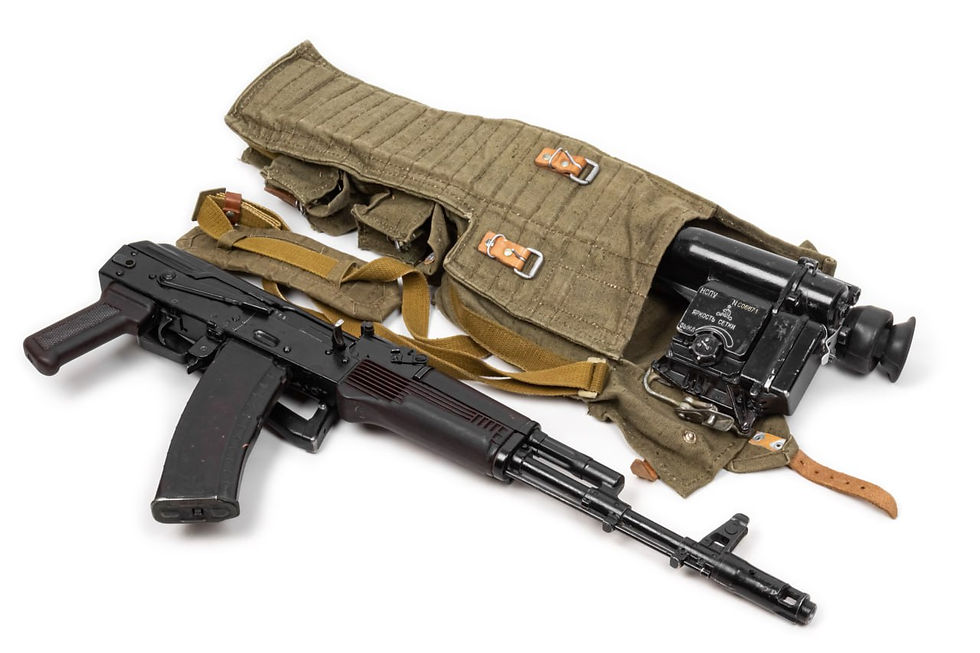
In service, the 1PN34 proved durable but limited. Image clarity was adequate at short to medium ranges, but performance degraded significantly in low-contrast or overcast conditions. Some modern users even claim that their 1PN27 scopes have better visibility than NSPU(M) which can well be the case.
The weight of 1PN34 affected weapon handling, yet it provided Soviet infantry with a basic night-fighting capability that had previously been absent (or rather limited).
1PN58 Night-Vision Scope
The 1PN58 represented an incremental improvement and was among the most widely exported Soviet night sights. Compatible with rifles such as the AK-74, RPK-74, and SVD, it was more versatile than earlier designs and featured improved light amplification.
Although still based on first-generation technology, the 1PN58 offered better image brightness and a slightly wider field of view. It saw extensive use in Afghanistan and later conflicts, where its robustness was valued more than optical refinement. The scope remained heavy and required careful battery management, but it was effective for ambushes and defensive fire at night in open grounds.
A clear visible difference between 1PN34 (NSPU) and 1PN58 (NSPUM) is the battery housing that changed from a box to a cylinder. The shape of the battery changed accordingly.
1PN51 Sniper Night Scope
1PN51 was a series upgrade of the Soviet night vision technology, both in terms of quality of the image and of the usability and compatability for different weapons system.
In short, this was now the second generation night vision device, providing confident target spotting at longer ranges, especially in winter, when potential targets gave higher contrast.

There is too much to say about 1PN51 for the scope of this article - it was truly a technical advancement. It will be covered in detail with good photography in our book:
1PN93 Night Sight
The 1PN93 marked a transitional step toward modern post-Soviet night-vision systems. Introduced in the late Cold War period and refined afterward, it was more compact and modular than its predecessors. Available in several variants, it was compatible with a wide range of small arms and benefited from improved image intensifier tubes.

Compared to earlier scopes, the 1PN93 offered better ergonomics, reduced weight, and improved reliability. It reflected a shift in Soviet and Russian doctrine toward more flexible infantry equipment and remained in service well beyond the Cold War era.


Comments