
Flashpoint! "At the Front Line of Today's Wars". Afghanistan by Ken Guest, Part Two - Infantry weapons of Mujahideen
This article is the second part of an extract from a book Flashpoint! "At the Front Line of Today's Wars". First part can be found here. The book, Flashpoint!, has been out of print for decades and it takes effort to find it on the secondary market. Luckily, the author of the chapter on Afghanistan, Ken Guest, has agreed to publish his part of the book in this blog. It will come in several parts, not only covering the Soviet-Afghan War from the side of the Mujahideen fighters, but also showcasing rare photography made by Ken, which was not published on the web before.

WEAPONS of the Afghanistan Mujahideen
Reports of Mujahideen fighting the Russians with antiquated black-powder jezzails can be dismissed as romantic fiction. While there were many old weapons around, including an assortment of black-powder weapons, few contemplated using them except while posing for photographs. When the war got under way antique weapons were more than offset by the huge volume of modern arms, and no self-respecting Mujahid would dream of confronting the conventionally armed Russian infantry with a black-powder musket. However, this did not impinge on the flow of heroic, contemporary folk-lore describing such uneven contests.
Even before the war, the possession of a weapon was a prerequisite to the Afghan sense of machismo. This was particularly true among the Pathans in the lands bordering Pakistan. Among these tribes honour demanded the participation in armed feuds, some of which dated back genera-tions. Although the Afghan Mujahideen made no weapons of their own, enterprising village gun-smiths in the adjoining Pakistani tribal lands turned out a ready supply of arms. Most of these locally produced weapons were inferior imitations of the originals. Nevertheless, when the war broke out in 1979 this region was already a well-stocked gun bazaar.
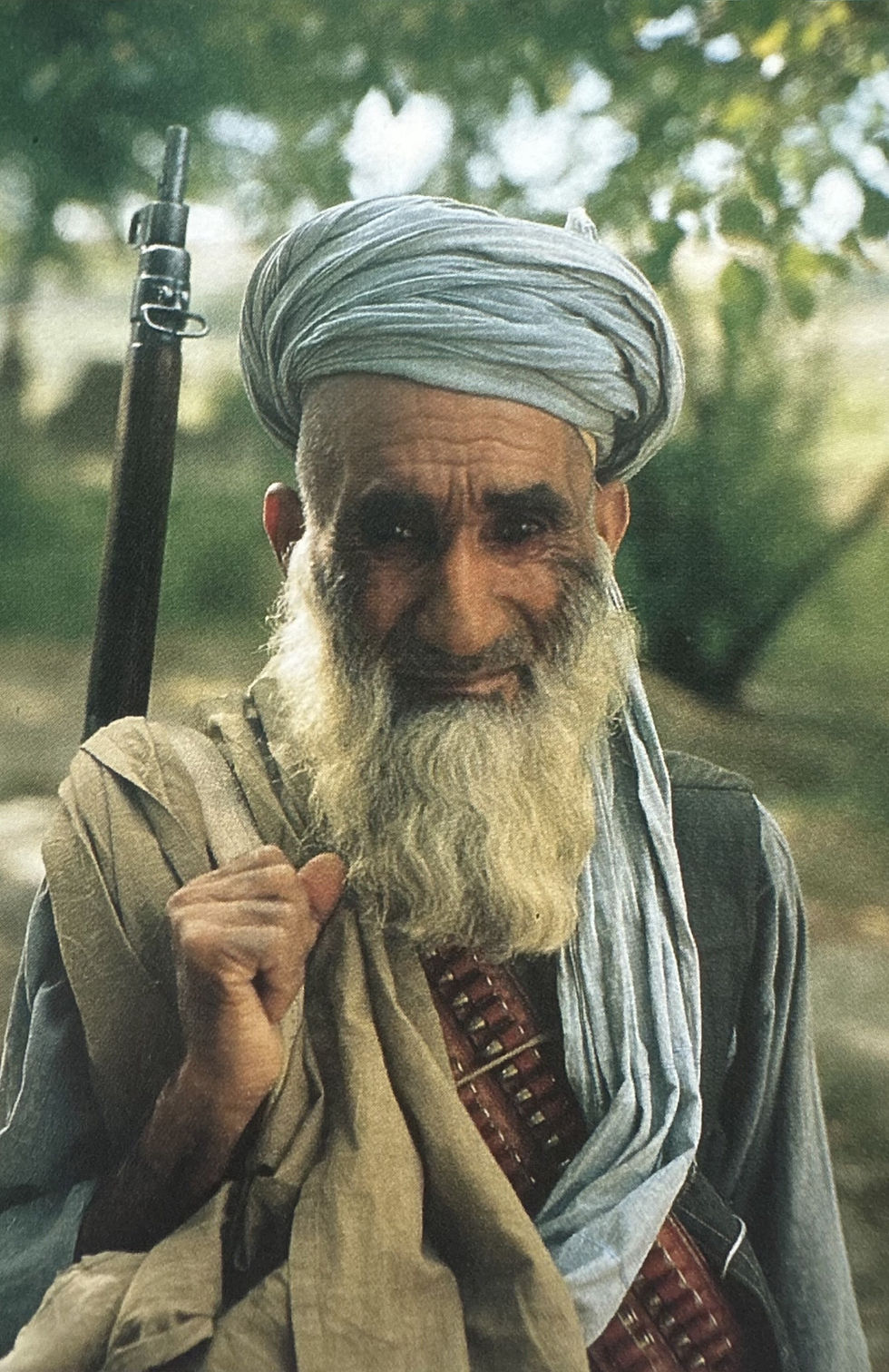
Armed resistance to the communist government in Kabul began before the Russian invasion as most Afghans considered communism 'un-Islamic' Although it was partly sponsored by Pakistan, which supplied both limited training and some arms, the largest single source of modern weaponry for the Mujahideen in this phase was the Afghan Army itself. Sometimes arms were seized by force, but far more came from deserting Afghan soldiers, who abandoned the government cause in their thousands. The Mujahideen were even able to obtain limited numbers of weapons from the Soviet forces. The Russians made the mistake of sending Islamic troops (conscripted from Soviet Central Asia) to Afghanistan, in the belief that they would be more acceptable to the Afghans. Most of the black market trading that took place with these troops occurred before the fighting became wide-spread. Soviet soldiers who indulged in this profi-teering had not yet had cause to feel threatened by the sale of a few weapons here and there. Despite these factors, weapons were not always available to the Afghans in sufficient quantities and at the right time. The speed with which the conflict esca-lated, from low-key, localised clashes into a war of nation-wide proportions, caught everyone off guard, including the Mujahideen.
The first consignments of Western-supplied arms appeared as early as 1980. Initially these were mostly old, stockpiled weapons no longer in service with Western forces. Rifles such as the tried and tested Mks IV and V .303 Lee Enfield were dated but mechanically sound. They were also rugged, easy to maintain and accurate up to 1,000 metres. Moreover, as bolt-action weapons with ten-round magazines, they imposed a degree of fire discipline absent among the Mujahideen, who were largely untrained.

The AK-47 Assault Rifle
As Afghan resistance to the Soviet occupation increased, the West began to improve the supply of weapons. Ideally the Mujahideen required small-arms that utilized the most readily available ammu-nition - Russian 7.62mm rimless rounds. The AK-47 and its many variants formed the natural choice, the most prolific types being Chinese Type 56 copies (Chinese copies of the Soviet SKS carbine were also common). These well made, sturdy weapons were immensely popular. By 1986 the AK-47 was by far the most dominant weapon among the Mujahideen. Surprisingly, despite the rifle's increased rate of fire in fully automatic mode (favoured by the Afghans), few Mujahids carried more than one or two 30-round magazines, relying instead on Providence to supply their needs. Many were to be fatally disappointed in time of crisis.
With the decline of the Lee-Enfield came a cor-responding drop in marksmanship. Only small numbers of Mujahideen, mostly older tribesmen, had truly mastered their weapons. Among the younger generation, volume of fire was more important than accuracy.

The AK-74
It was not long, before another weapon was to lead the Mujahideen wish-list - the new Soviet 5.45mm AK-74, known locally as the Kalikov. When these first appeared in small numbers in 1981 the Afghans reported that they fired 'poison' bullets owing to the high fatality rate among men hit by the new, smaller rounds.3 Later, as more Soviet troops were equipped with the weapon, larger numbers of AK-74s appeared in Mujahideen hands, though the supply of ammunition remained a problem.

Light Machine Guns (LMGs)
Supplementing the firepower of the assault rifles were light machine guns. The most prolific among these was the 7.62mm belt-fed RPD, dubbed Schul Daz by the Mujahideen after its belt of 100 bullets. There were also old Goryunon SG43s, mostly used for air defence, and a few examples of the Czech 7.92mm ZB30 (from which the British had devel-oped the more famous and almost identical Bren Gun).

Heavy Machine Guns (HMGs)
By 1981 the Mujahideen had also received con-signments of the DShKM 12.7mm HMG, known to them as the Dashaka. These were deployed in large numbers and were most often used for air defence, although occasionally also in direct sup-port of ground attacks against enemy posts. About the same time 14.5mm ZPU-1 and ZGU-1 HMGs (or Zirgriots) were appearing. Difficult to portage, these were used exclusively for the air defence of fixed bases. The Mujahideen were extremely proud of these weapons and keen to fire them, and any base which possessed one had a tendency to echo to the sound of constant 'test' firing at nearby ridges.

Rocket-Propelled Grenades (RPGs)
Among a range of support weapons, the mainstay of the Mujahideen anti-armour arsenal was the RPG-7. While this lightweight weapon gave them some close protection against Soviet armour, it was not popular as a personal weapon. Operators had to get close and rarely had the opportunity to fire more than one or two shots. Nevertheless, it was an essential weapon and was responsible for the destruction of hundreds of Soviet tanks, armoured cars and trucks. The Mujahideen also used it extensively against fixed positions.
With ever greater numbers of RPG-7s (and Type 69 Chinese copies) reaching Mujahideen hands, modifications were introduced to Soviet armour to limit the effects of any hits. Skirt armour and turret blocks were added, although the rear doors of BMP armoured personnel carriers remained vulnerable, not least because they doubled as fuel tanks!

Recoilless Rifles
Both the 75mm recoilless rifle and, later, the smaller, more portable 82mm, were used by the Mujahideen. They were deployed more frequently as direct-fire weapons against fixed enemy posi-tions than against moving armour. Alternatively, they were sometimes used at extreme range as a mobile light artillery.
If the Mujahideen were hard-pressed, heavy weapons were abandoned in favour of a rapid retreat into the hills. The 75mm recoilless rifle, being large and heavy, was often lost by its owners during Afghan Army and Soviet ground offensives.

Mines
The Mujahideen made much use of mines. These might be laid individually, on roads linking Soviet positions, or en masse, to blunt Soviet offensives. While they undeniably caused many Soviet casual-ties during the war, there were also a lot of 'own goals' among the Mujahideen: local commanders operated independently and were invariably oblivi-ous to the whereabouts of mines laid by other Mujahideen factions, often with fatal conse-quences.
Mortars
The most useful support weapon possessed by the Mujahideen was the Russian M1937 82mm mortar. It was man-portable and could be transported over precipitous mountains and easily assembled. The high trajectory of the weapon enabled it to be sited in a gully, protected from direct return fire by tanks, heavy machine guns or small-arms. Its main disad-vantage was that it required a trained crew. While the Mujahideen were enthusiastic bombardiers, they did not generally have the skill to use the full potential of the weapon, although, with plenty of opportunity for practice, some did become profi-cient. Chinese 60mm mortars were also used. While these were light and mobile, they lacked hit-ting power, particularly against fixed or entrenched positions.

The Soviets used their greater range of mortars (82mm to 160mm) to far greater effect. Trained Soviet mortar crews brought their weapons into action much faster than ad hoc Mujahideen crews although, against widely dispersed guerrillas on precipitous terrain, the damage might still be sur-prisingly slight. Nonetheless, Soviet teams worked in coordination with one another, increasing the effectiveness of the barrage. Around fixed bases they used predesignated Defensive Fire Zones (DFZs). To be caught in a Soviet DFZ was no laughing matter.


I’m curious about the AK-74 section. When the Mujahideen called the FNF rounds "poison" bullets, was that mainly because of the reported fatality rate, or were there other reasons behind that belief?